

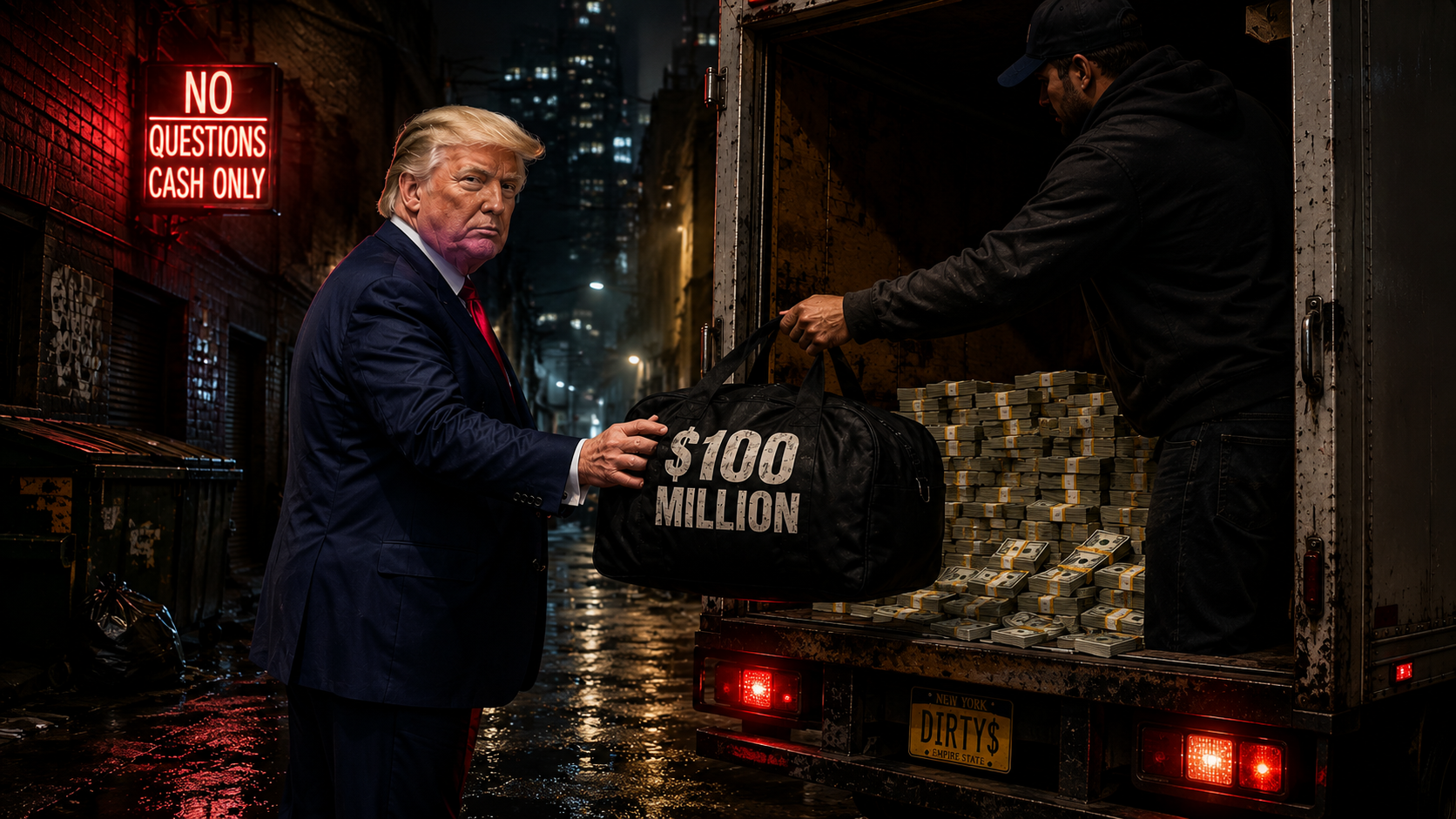
A failed flooring retailer arrested by British authorities in 2021 became one of the largest buyers of tokens from the president’s company, and as much as $75 million of that money went to Trump and his sons.
Two years before he handed $100 million to the Trump family’s cryptocurrency venture, Guren “Bobby” Zhou was a hardwood flooring retailer in England whose companies had collapsed, whose crypto start-up had burned through millions of dollars in investor money, and who had been arrested on suspicion of money laundering by the country’s National Crime Agency. A New York Times investigation published Sunday traced how that man ended up as one of the biggest financial backers of World Liberty Financial, the digital asset company controlled by President Donald Trump’s three sons.
Under the company’s own revenue arrangement, as much as $75 million of Zhou’s purchase was distributed to an entity controlled by the president and his sons, with additional benefit flowing to the family of Steve Witkoff, the administration’s special peace envoy, whose son Zach Witkoff is a founding partner of the firm. Where Zhou got the money remains unknown.
The Man Behind Aqua 1
When the $100 million purchase was announced in June of last year, the buyer was identified only as Aqua 1 Foundation, a United Arab Emirates entity with no public track record and a website created roughly one month earlier. It was the largest known purchase of World Liberty tokens at the time, and the company’s co-founder, Zak Folkman, publicly welcomed the partnership as validation of the venture’s global ambitions.
Reuters first connected Aqua 1 to Zhou months later, reporting that Eric Trump had personally pitched him during a Dubai roadshow in May 2025 and that the entity had been renamed in the British Virgin Islands from Web3Port only weeks before the purchase was disclosed. The Times investigation, built on dozens of interviews with former associates along with confidential documents and court records, fills in what World Liberty either did not find or did not care to find.
Zhou’s visa had expired in 2018, and his application to remain in Britain was denied in part because he had been arrested in March 2021, alongside several others, on suspicion of money laundering. That fact appeared in a publicly posted immigration judgment in February 2024, more than a year before the World Liberty deal closed. A court record filed last November alleges that Zhou took part in a laundering operation dating back to 2019, and British officials confirmed last month that the investigation remains active. Two of his longtime employees have since been charged; one has pleaded guilty, and a trial for the remaining defendants is scheduled for 2028. Zhou himself is the only one of the six people named in the indictment who has not been charged, and he has left the country.
A Business History Built on Announcements That Were Not True
The Times examination describes a career pattern that would be difficult to miss in even a cursory review. Zhou moved to England in 2005 for graduate school and built a hardwood flooring business around a product his father milled in China, eventually running a small chain of retail stores. In 2018, he put those companies into administration and sold the stores without repaying the roughly $5 million his own books showed he owed his father’s company.
His next venture, a metaverse crypto project called Caduceus, was marketed through a series of announcements claiming institutional backing that the named institutions say never existed. The London subsidiary of a Chinese state-owned securities firm told the Times that its name was used without authorization and that a claimed $1 billion venture fund was not real. A senior executive at an Abu Dhabi royal family investment group said he had met Zhou socially but had never done business with him or with Caduceus, and the group described the representations made to investors as unauthorized and false. A German bank Zhou claimed to help lead told the Times he had never held a position there.
The Caduceus token peaked at $2.24 in July 2022 and was effectively worthless within two years. Employees who had worked for token options rather than salary got nothing. One executive Zhou hired to run a subsidiary put it bluntly to the Times, saying ”We had nothing to show for that money, apart from Bobby’s lifestyle.”</a>
Retired General Wesley Clark, the former NATO Supreme Allied Commander, was approached earlier this year about appearing at an Abu Dhabi event with Zhou’s company. Clark told the Times his office ran a background search, learned of the money laundering investigation, and instructed his team to cut off contact. Zhou’s companies issued a press release naming him anyway. Several other business professionals told the Times they had walked away after researching him. World Liberty Financial did not.
How World Liberty Financial Works
World Liberty launched in September 2024, with Trump listed as co-founder emeritus and his sons, Donald Jr., Eric, and Barron, attached to the venture. The company sells a governance token called WLFI and issues a dollar-pegged stablecoin called USD1. Under the licensing arrangement Reuters documented, 75% of net token sale revenue was directed to a Trump family entity called DT Marks DEFI LLC.
The structure means the president collects a cut of purchases made by buyers he does not have to identify, from jurisdictions he does not have to disclose, using an asset class his own administration has spent 18 months deregulating. Days before Trump’s second inauguration, a firm backed by Abu Dhabi’s deputy ruler bought a 49% stake in World Liberty, routing $187 million to Trump family entities and $31 million to entities tied to the Witkoffs. The same Emirati orbit later moved $2 billion via USD1 to the crypto exchange Binance, whose co-founder, Changpeng Zhao, received a presidential pardon.
A World Liberty spokesman told the Times the company follows all applicable laws and maintains a compliance program that meets or exceeds industry standards. He declined to say whether the company knew the source of Zhou’s money. A digital asset investigator interviewed by the Times said the combination of Zhou’s business failures, his sudden access to wealth, the size of the transaction, and the open investigation should have triggered a documentation requirement under anti-money laundering rules, and that the Trump family’s status as politically exposed persons should have brought the highest available level of regulatory scrutiny.
Trump’s $1.4 Billion Crypto Year
The Zhou transaction is not an outlier. It is a sample of the machinery.
Trump’s annual financial disclosure, released by the Office of Government Ethics on June 30, put his 2025 crypto income at roughly $1.4 billion, the largest single component of the approximately $2.2 billion he reported, dwarfing his earnings from real estate. The filing ran 927 pages, compared with the eight pages Barack Obama filed in his final disclosure and the 11 pages Joe Biden filed in his.
The breakdown includes $635 million in royalties tied to the $TRUMP meme coin he launched three days before taking office, more than $500 million from World Liberty token sales, roughly $65 million from equity sales in the firm controlling World Liberty, and more than $290 million classified as income from crypto wallets associated with the venture. Entities connected to the company also reported income from Bitcoin, Ethereum, and a range of altcoins without the disclosure explaining how those positions generated returns. The president’s World Liberty income for 2025 was roughly nine times what he reported the year before.
As the Times noted in its report, the majority of that $1.4 billion came from anonymous sources.
Congress Has Asked Questions and Received Almost Nothing
Democratic lawmakers have spent more than a year requesting records, and Republican committee chairs control whether any of those requests carry subpoena power. Senators Elizabeth Warren, Richard Blumenthal, Gary Peters, Dick Durbin, and Ron Wyden formally requested hearings on the national security implications of last month’s disclosure. Dozens of House Democrats have separately pressed Treasury Secretary Scott Bessent to investigate conflicts of interest tied to World Liberty’s pending bank charter application, which is reviewed by an independent arm of the Treasury. Warren and Senator Jack Reed have asked the Justice Department and Treasury to examine the company’s failure to detect ties to sanctioned criminal networks.
Meanwhile, the ethics provisions in the crypto market structure legislation moving through the Senate would not stop any of this. A Banking Committee minority staff analysis of the language released in July found that the loopholes are wide enough to permit the next $1.4 billion, and that enforcement would fall to a Justice Department the president staffed himself.
A White House spokeswoman told the Times that Trump has no conflicts of interest and acts only in the interest of the American public.
The court records documenting the money laundering investigation into Zhou were sitting in a searchable public database the entire time. General Clark’s staff found them in the course of ordinary due diligence and walked away. World Liberty Financial either did not look or looked and proceeded anyway, and either answer should concern anyone who believes a sitting president should not be collecting nine-figure payments from strangers.