


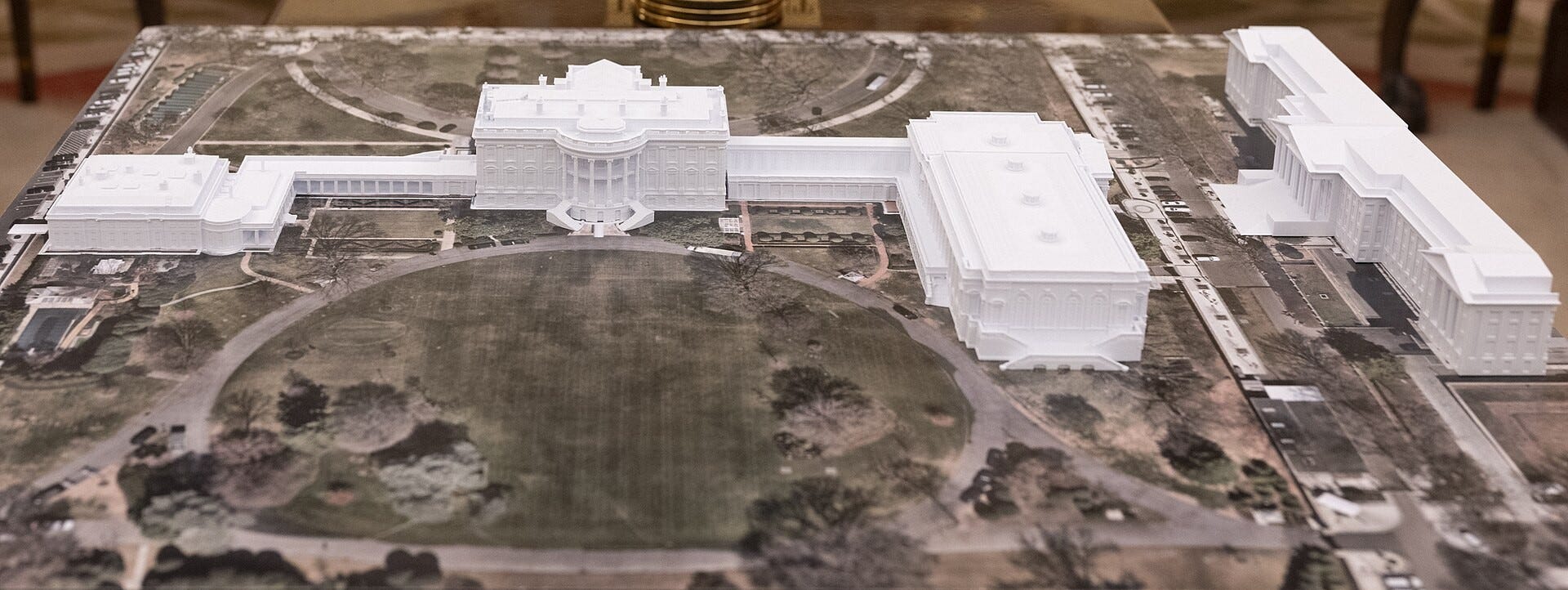
A federal appeals court ruled Friday that Donald Trump has no legal authority to build his 90,000 square-foot ballroom on the ruins of the White House East Wing, upholding an injunction that blocks above-ground construction until Congress signs off on the project.
The two-to-one decision came from Judges Patricia Millett and Bradley Garcia, with Judge Neomi Rao dissenting, and it opens with a sentence that reads less like a legal holding than a civics lesson. Each president is a temporary tenant, not the owner, of the White House and its Executive Residence, the court wrote, noting that the president has no constitutionally assigned authority over a property designed and maintained for the use of all presidents and for the American people.
The panel was blunt about the history it could not find. The judges wrote that they are aware of no instance in American history in which a president unilaterally used privately collected funds to demolish substantial portions of the White House that Congress had authorized and taxpayers had paid for. Until now.
Under the Constitution’s Property Clause, Congress holds plenary control over the White House and the land around it, and a 1912 statute still on the books bars any building or structure from going up on federal parkland in the District of Columbia without express authority of Congress.
The administration could not point to any statute that clears that bar. The court found that the National Trust for Historic Preservation had shown, compellingly, that Congress has not ceded unfettered authority to the executive branch to dramatically redesign, reshape, and reconstruct the People’s House to fit a particular president’s desires.
The judges were careful to say what the ruling is not. The holding has nothing to do with whether a ballroom is a good idea as a matter of policy, and it does not necessarily mean the ballroom can never be built — only that it cannot be built without securing Congress’s authorization, as the Constitution and laws require.
The court stayed its own decision for fourteen days so the administration can seek Supreme Court review, which is almost certainly where this lands next. An exception for below-ground bunkers, bomb shelters, and military and medical infrastructure keeps that work moving, so the security features Trump has spent months invoking are unaffected.
How we got here
The project was announced in a July 2025 press release, promising a ballroom funded by private donations and substantially separate from the main White House building, with a commitment that the administration would work with the appropriate organizations to preserve the site’s history. Trump said at the time that the project would not interfere with the current building.
The National Park Service ran an environmental assessment that August and concluded the project would cause permanent adverse impacts on the cultural landscape of President’s Park, disrupt the historical continuity of the White House grounds, and create a visual imbalance with the more modestly scaled West Wing and Executive Mansion.
The agency found no significant impact, reasoning that photographs of the old East Wing and the salvage of select historic materials would preserve enough of the historic fabric. It then declined, without explanation, to publish either document.
Then came the backhoes. In October 2025, over just three days and without the promised consultations or congressional permission, the entire East Wing was demolished, a structure that had stood since 1902, been renovated in 1942, and housed the first lady’s offices along with dozens of other workspaces.
The price tag climbed from an initial estimate of $200 million to $300 million during demolition week, and by the time the White House released a roster of 37 donors covering the now $400 million cost, the list included Meta, Apple, Google, and Amazon alongside the Adelson Family Foundation, Commerce Secretary Howard Lutnick’s family, Blackstone CEO Stephen Schwarzman, and crypto billionaires Cameron and Tyler Winklevoss.
The National Trust, a nonprofit chartered by Congress in 1949 to facilitate public participation in preserving sites of national significance, sued that December to pause work until the government completed the federal reviews standard for any federal building project. Its complaint made a simple argument: no president is legally permitted to tear down portions of the White House without any review whatsoever, and no president is legally permitted to build a ballroom on public property without allowing the public to weigh in.
The government’s defense shifted repeatedly as the case moved. Early on, the administration argued the Executive Office of the President and the Office of the Executive Residence were running the project, and since neither is an agency under the Administrative Procedure Act, there was no agency action for the court to enjoin. Judge Richard Leon, a George W. Bush appointee, initially denied the Trust’s requests, relying on government assurances that above-ground designs were not final and that nothing irreversible would happen during underground work. He warned that he would hold the government to its word, and that if below-grade construction dictated the size or scale of the ballroom, the government should be prepared to take it down.
Then the Trust amended its complaint to add an ultra vires claim, and the ground shifted. Suddenly, the administration argued that the Park Service had independent authority to build the ballroom after all, a reversal that surprised the district court, since the government had previously prevailed in seeking a denial of injunctive relief by insisting the Park Service had no role in the project at all.
Leon enjoined above-ground construction on March 31, writing that no statute comes close to giving the president the authority he claimed and that the president is the steward of the White House for future First Families, not its owner.
What followed was a months-long fight over what the injunction actually covered. The DC Circuit sent the case back for the district court to clarify how the order affected safety and security plans.
On remand, the administration told Leon that the below-ground security upgrades were inseparable from the ballroom design, that the two could not exist in isolation, and that the entire project therefore advanced national security as an integrated whole, meaning the injunction had no practical effect and everything could proceed.
Leon did not take that well. He pointed out the claim was in direct conflict with the government’s prior representations, which had repeatedly described the underground and above-ground elements as independent of each other and had assured him the below-ground work would not lock in the ballroom’s design.
He wrote that national security is not a blank check to proceed with otherwise unlawful activity, and that belated assertions about inseparability were not an occasion to reweigh the equities. He then rewrote the order to spell out exactly what could go forward, green-lighting the underground bunker along with above-ground work strictly necessary to cover and protect it, measures for the personal safety of the president and his staff, and construction needed for waterproofing, structural reinforcement, and sealing exposed areas. He added that he had no desire or intention to be dragooned into the role of construction manager.
The security argument gained political traction in the spring. After a shooting at the White House Correspondents’ Association dinner in late April, some congressional Republicans began pushing for public funding on security grounds, even as Trump kept insisting the ballroom was taxpayer-free with no taxpayer putting up ten cents. Public money was already flowing into the underground work, and the president’s budget projected $377 million in White House renovations this year plus another $174 million for fiscal 2027, an 866% increase over the roughly $39 million spent in fiscal 2025.
The public was never on board. When the Commission of Fine Arts took up the plans, it received a record 2,000 public comments, 99% of them critical of the proposal.
At oral argument in June, the panel appeared unpersuaded that national security claims justified the project, with Justice Department attorney Yaakov Roth arguing that courts have no role in weighing a privately funded project and that blocking it would have been improper at any point.
That argument lost. The court affirmed the injunction and rejected each statutory theory the administration offered, including the claim that a routine appropriations authorization for the care, maintenance, repair, alteration, and improvement of the Executive Residence somehow empowers a president to raze a wing of the White House and rebuild it with donor money. As the judges put it, that reading would grant the president unilateral authority to carry out any construction project, up to and including demolishing and replacing the entire White House, with any source of funding he can identify.
There is a two-week clock running now. Whatever the Supreme Court does with it, the East Wing is already gone, torn down in three days by a president who asked no one’s permission and then spent eight months in court explaining why he never needed it.
Democratic Reporter is 100% funded by its readers. Please considering subscribing to our Substack account. Even a free subscribe helps us reach more people while maintaining our focus on holding Donald Trump, his administration, and the entirety of the GOP accountable for their actions.


