


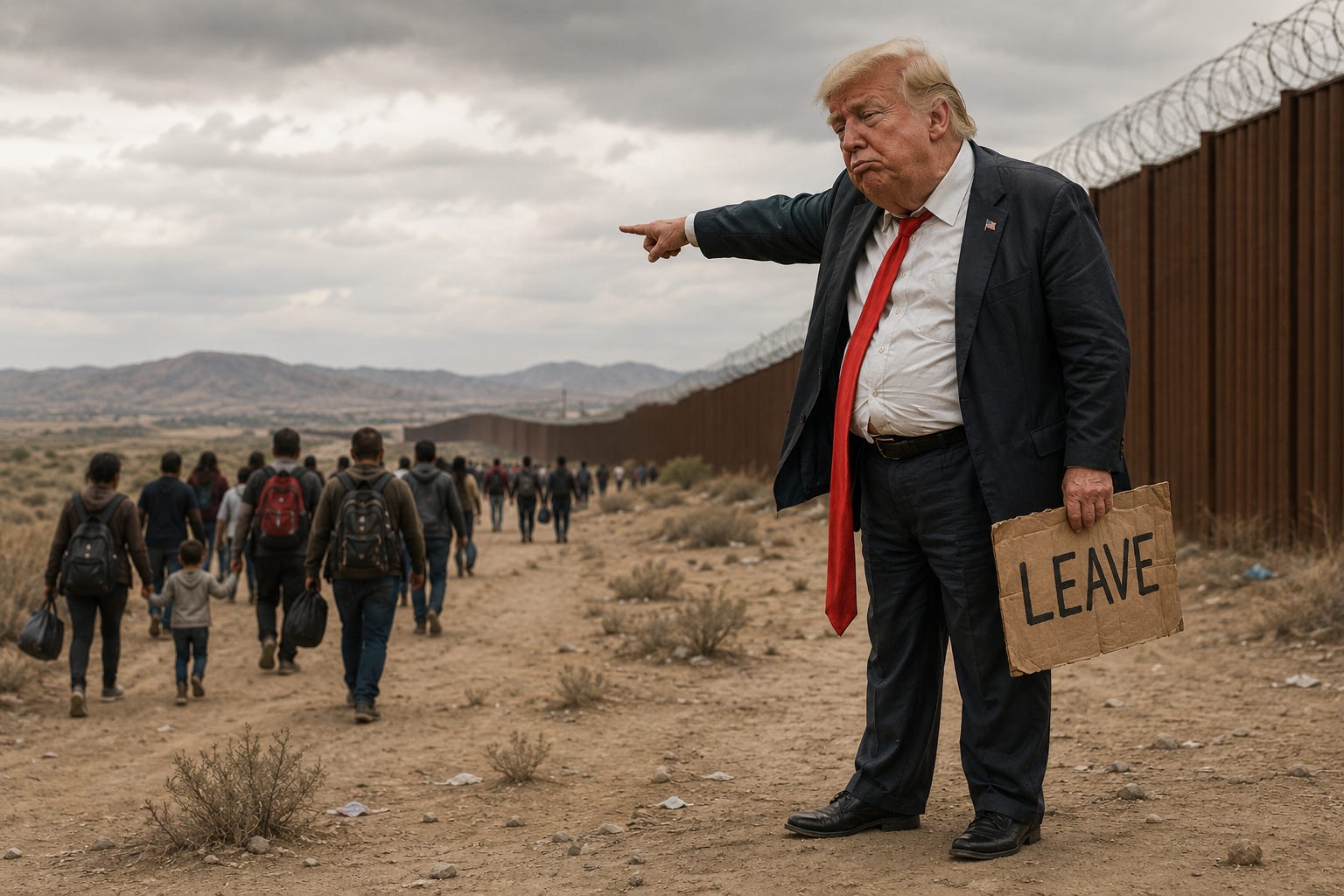
President Donald Trump signed two executive orders Thursday designed to strip birthright citizenship from thousands of people born on American soil, five weeks after the Supreme Court ruled that his first attempt to do so was unconstitutional.
The orders take a different route than the one the justices blocked. Instead of declaring outright that the Fourteenth Amendment does not cover the children of noncitizens, the new directives carve out four specific categories that the administration claims fall within narrow exceptions the Court left standing. A companion order directs the State Department and the Department of Homeland Security to stop pregnant travelers from entering the country in the first place.
Trump made no effort to disguise his motivation. Speaking in the Oval Office, he called the June ruling a “very, very unfortunate decision” and said his administration was making adjustments because he considers the outcome unfair. Asked whether the new orders would survive a constitutional challenge, he said he thinks they will.
What the first order does
The order barring federal agencies from issuing citizenship documents to four new categories of newborns applies when neither parent is a U.S. citizen and any one of the following conditions is met. Agencies are also forbidden from accepting state or local documents that recognize citizenship in those cases.
Parents designated as alien enemies. The order covers any parent who belongs to a designated Foreign Terrorist Organization or has been named a Specially Designated Global Terrorist. Those designations are made by the executive branch itself, which means the administration would control who lands in the category.
Parents employed by a foreign government. This sweeps in ambassadors, nationals working at their country’s embassy or consulate, anyone employed by a foreign government in an official capacity, and employees of international organizations who hold immunity. The historical diplomatic exception has always been narrow. This extends far beyond ambassadors and their families.
Parents who entered a commercial birth arrangement. The category applies when parents paid to have the mother present in the United States or one of its territories to give birth, or contracted with a surrogate in the United States for the same purpose.
Births in territories where Congress has not granted citizenship by statute. Residents of Puerto Rico hold citizenship through federal law rather than the Constitution, so this provision has no immediate effect there. It would only take hold if Congress repealed that statutory guarantee, and a bill introduced last month to do exactly that is not expected to pass.
The order gives every federal department and agency 30 days to publish guidance on how it will carry out the policy, and it names the Secretary of State, the Attorney General, the Secretary of Homeland Security, and the Commissioner of Social Security as the officials responsible for bringing their agencies into line. A severability clause is built in, an acknowledgment that the White House expects courts to strike down at least part of it.
What the second order does
The companion order delegating the president’s entry authority to the State and Homeland Security secretaries defines birth tourism far more broadly than the commercial schemes the administration described publicly. Under the text, birth tourism means the entry of any foreign national on any nonimmigrant visa for the purpose of giving birth on American soil, along with any effort by a foreign national to help someone else do so.
The order authorizes both secretaries to:
Deny a visa or any other travel authorization to anyone they believe intends to give birth in the United States
Revoke an existing visa and permanently bar entry for anyone who enters or attempts to enter for that purpose
Deny entry to or remove anyone who previously gave birth here or is believed to be planning to
Take action against organizations, companies, and individuals inside or outside the country accused of facilitating the practice
Both secretaries may grant exemptions on humanitarian grounds or when they decide an individual’s entry serves the national interest. Nothing in the order defines those terms or establishes any process for requesting an exemption.
The definition of Trump’s order requires neither a commercial arrangement nor fraud. A student, a temporary worker, or a visitor with family here would fall inside it if a consular officer concluded that giving birth was part of the purpose of the trip. The provision covering anyone who helps facilitate entry could reach relatives already living in the United States.
Pressed on how officials would actually determine a traveler’s intent, or how far into a pregnancy someone would have to be before being turned away, White House officials acknowledged the practice is relatively uncommon and declined to provide details. They pointed instead to a general provision of the Immigration and Nationality Act.
The legal problem the orders cannot solve
On June 30, the Supreme Court held in Trump v. Barbara that children born in the United States to parents who are unlawfully or temporarily present are citizens at birth under the Citizenship Clause of the Fourteenth Amendment. Chief Justice John Roberts wrote the majority opinion, joined by Justices Sonia Sotomayor, Elena Kagan, Ketanji Brown Jackson, and Amy Coney Barrett. Justice Brett Kavanaugh concurred in the judgment and dissented in part. Justice Clarence Thomas dissented, joined by Justices Samuel Alito and Neil Gorsuch.
The ruling voided Trump’s Inauguration Day directive declaring the children of undocumented and temporary residents outside the Citizenship Clause. The administration never asked the Court to reconsider, letting the deadline for rehearing pass without filing.
Thursday’s order cites that decision directly, quoting the majority’s own language before proceeding to define categories the majority never endorsed. Officials described the strategy in advance as an attempt to operate within exceptions the Court left standing rather than a challenge to the ruling itself. The exceptions the Court actually recognized are the ones rooted in more than a century of precedent, covering children of accredited diplomats and of members of a hostile occupying force. Neither has ever been read to reach embassy staff, consular employees, or people the executive branch decides to label enemies.
Birth tourism, meanwhile, is already illegal. Federal regulation adopted during Trump’s first term bars the issuance of a tourist visa when the primary purpose of travel is to obtain citizenship for a child born in the United States, and immigration officers already have authority to turn away a traveler they believe is coming for that reason. Estimates of how many births result from the practice range from the low thousands to the tens of thousands each year, a rounding error against roughly 3.6 million annual U.S. births.
What happens next
Both orders will be challenged. The coalition that beat the administration at the Supreme Court, led by the American Civil Liberties Union, the Legal Defense Fund, the Asian Law Caucus, and the Democracy Defenders Fund, has already prevailed once on this exact question, with a 6-3 majority behind it.
In the meantime, the practical damage begins immediately, with federal agencies receiving just 30 days to issue guidance instructing their employees to withhold passports, Social Security numbers, and citizenship documents from newborns whom the Constitution protects. Consular officers overseas have been handed broad discretion to deny visas and impose permanent bars based on a guess about why a woman is traveling. Families will be caught in that machinery long before any court gets to say whether the machinery is lawful.
That is the point. A president who lost at the Supreme Court has decided the ruling is a suggestion, and he is betting that the delay between an unconstitutional order and a judicial remedy is long enough to do real harm.
Democratic Reporter exists because the Trump administration counts on you not paying attention. We read the orders, we check the record, and we tell you what they actually say. Subscribe and share this with someone who needs to see it.


