


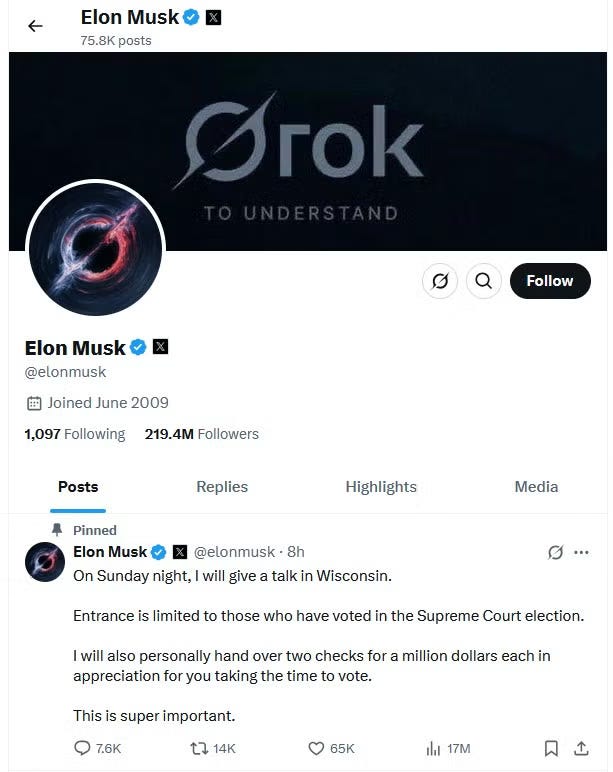
The tweet Elon Musk deleted may finally have caught up with him.
The Wisconsin Elections Commission has found probable cause that the billionaire violated the state’s election bribery law during the 2025 Wisconsin Supreme Court race, referring two complaints to the Brown County district attorney’s office for possible criminal prosecution. The commission — a bipartisan body composed of three Democrats and three Republicans — voted 5-1 in closed session on July 9 to make the referral, according to commission spokesperson Emilee Miklas.
The motion approved by the commission found probable cause that Musk broke Wisconsin law by making a social media post offering $1 million to individuals who voted in the Supreme Court election “in order to induce them to vote in that election.”
Brown County District Attorney David Lasee, a Republican, now has 40 days to report back to the commission on whether he will pursue charges. Lasee did not immediately respond to requests for comment, and neither did spokespeople for Musk.
The Deleted Post at the Center of the Case
The referral traces back to a post Musk published on X late on March 27, 2025, just days before the election. In it, Musk announced a rally in Green Bay open only to people who had already voted in the Supreme Court race and promised to “personally hand over two checks for a million dollars each in appreciation for you taking the time to vote.”
Wisconsin law makes it a felony to offer, give, or promise anything of value to induce an elector to vote or refrain from voting. Legal experts flagged the post as a likely violation almost immediately, and Musk deleted it roughly 12 hours later. He then posted a revised version claiming the checks would instead go to two people serving as “spokesmen” for a petition against so-called activist judges.
The reworded offer did not stop the giveaway. At the Green Bay rally on March 30, Musk handed $1 million checks to two Wisconsin voters — one of them the chairman of the Wisconsin College Republicans. A third voter also received a check. Wisconsin’s Democratic attorney general, Josh Kaul, had sued to block the payments, but state courts declined to intervene before the event.
Musk’s attorneys have argued the giveaways were protected free speech intended to build a grassroots movement rather than to advocate for any candidate. A separate civil lawsuit pending in Brown County alleges that Musk and two groups he funds violated prohibitions on vote bribery and unauthorized lotteries.
A $20 Million Bet That Failed
Musk was the dominant outside force in the 2025 Supreme Court race, with the billionaire and groups he supported spending at least $20 million to back Brad Schimel, the Republican-endorsed candidate. Two weeks before the election, Musk’s political action committee also offered $100 to voters who signed a petition opposing “activist judges” — a tactic nearly identical to the $1 million-a-day voter sweepstakes his PAC ran in battleground states before the 2024 presidential election.
None of it worked. Schimel lost to Democratic-backed candidate Susan Crawford by 10 percentage points in a race whose total spending topped $100 million, making it the most expensive judicial election in American history. Crawford’s victory preserved the liberal majority on the Wisconsin Supreme Court, which expanded to 5-2 this year after Democratic-backed candidate Chris Taylor won her own race.
A month after the loss, Musk announced he would sharply scale back his political spending.
What Happens Next
The decision now rests with Lasee, whose county includes Green Bay, where one of the two confidential complaints originated; the other came from a Milwaukee voter. If the district attorney declines to act, the commission’s probable cause finding will still stand as a rare formal rebuke — a bipartisan panel concluding that the world’s richest man likely committed election bribery in a battleground state.
For now, the question is simple: whether deleting a tweet erases the crime it described, or whether accountability finally applies to billionaires too.
Democratic Reporter is funded by readers like you — no corporate owners, no billionaires. If you value independent political journalism, subscribe and share this piece.


