


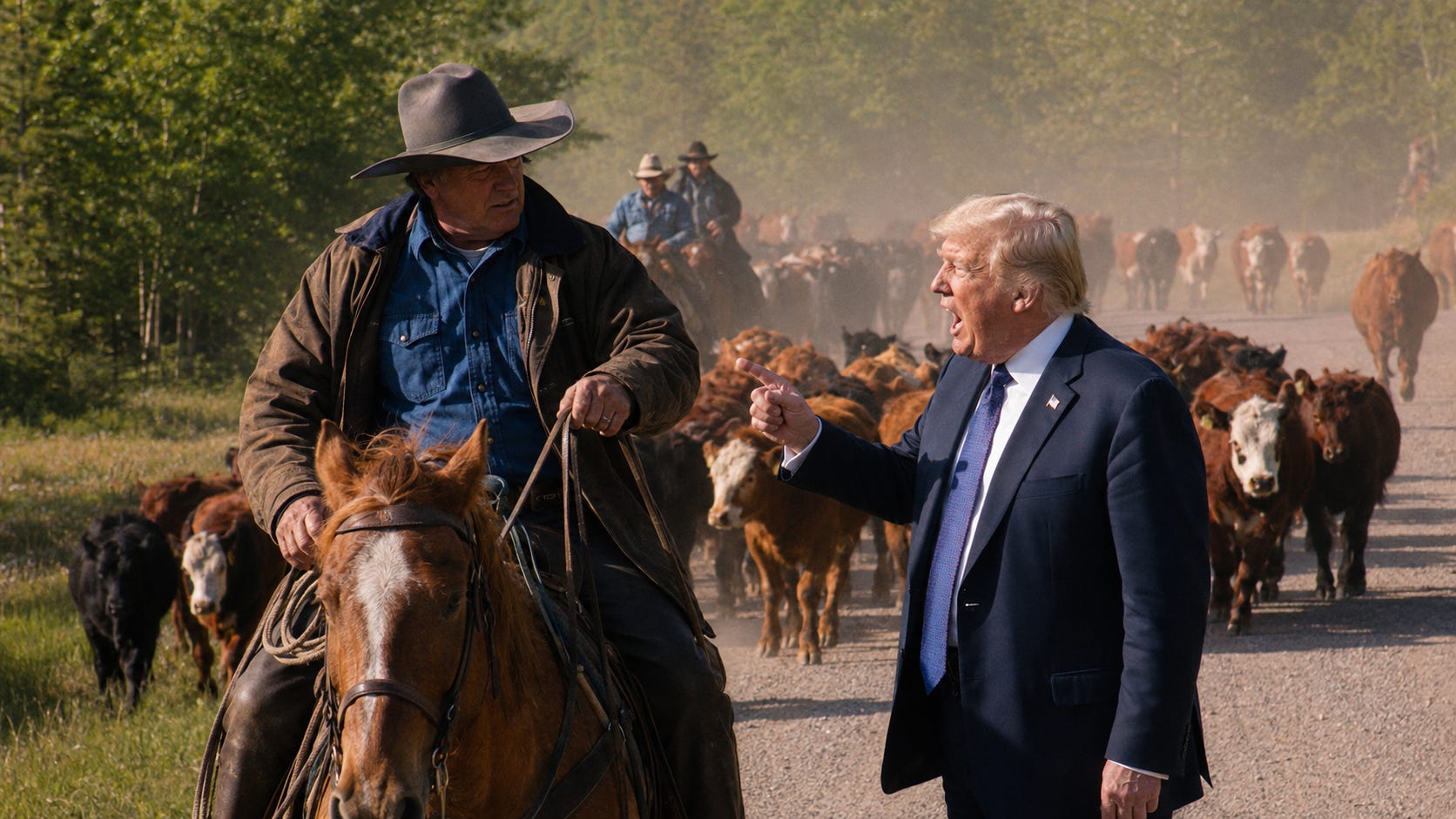
On Friday, Donald Trump said the United States will let in up to 300,000 metric tons of ground beef over the next 90 days without the usual tariffs, and claimed it will sell for 25% less than current prices. When reporters asked, he would not say which countries are involved.
A White House official said an executive order will be signed in the next two weeks, but the administration has not explained which suppliers made the pricing promise or how the border discount will reach shoppers.
The U.S. Cattlemen’s Association pointed out that the 90-day period runs through November, which is when the midterm elections take place. When asked about criticism, Trump told reporters, “That’s what the voters want.”
Ranchers Definitely Didn’t Want This

Live cattle futures fell $3 to $4 per hundredweight when the post went up, with feeders down as much as $6, before recovering most of the losses by the close of trading that afternoon. The National Cattlemen’s Beef Association said it was disappointed and described the plan as “government-subsidized, below-market beef” that will not rebuild the American herd.
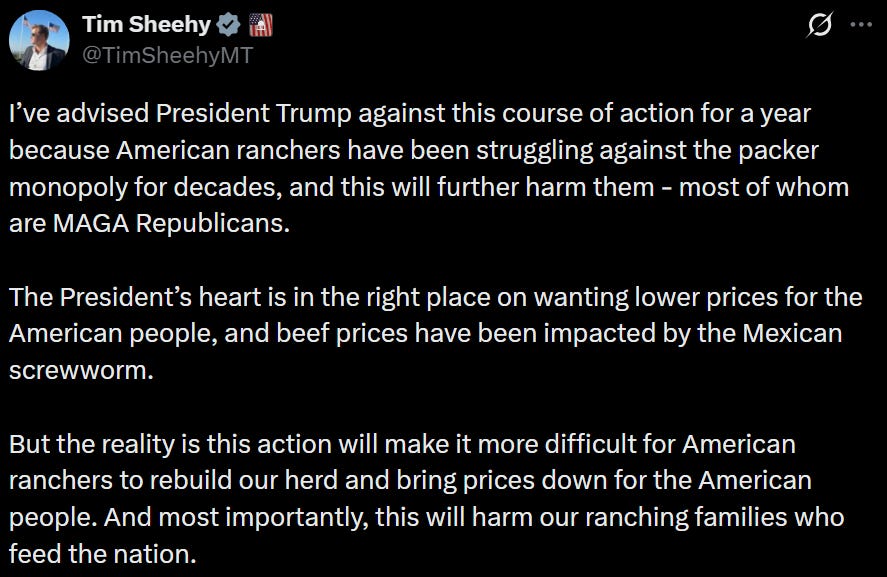
The sharpest criticism came from Republicans. Senator Tim Sheehy of Montana wrote that he had advised Trump against this for a year, that ranchers have been struggling against the packer monopoly for decades, and that this will harm them, “most of whom are MAGA Republicans.” Chuck Grassley tied his concern to the Tyson plant closure in Illinois, writing that “USA cattlemen should always be put 1st thru America 1st policies.”
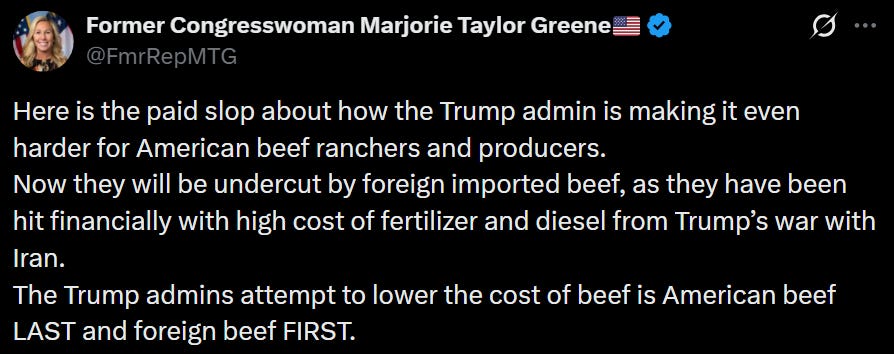
Deb Fischer, a cattle rancher herself in Nebraska, said she was “extremely disappointed” by the decision. Thomas Massie blasted the deal on X, calling it a “slap in the face to American cattlemen & consumers.” Marjorie Taylor Greene, now out of Congress, posted the president’s own announcement and declared it “American beef LAST and foreign beef FIRST.”
The top cattle industry lobbyist in Washington told ABC News that many producers are frustrated and feel like “this isn’t what they voted for.” This group gave 95% of its political donations to Republicans in the 2024 cycle.
The company that did ask for it
Last fall, Wesley Batista, one of the billionaire brothers who run JBS, argued that American production cannot meet demand, saying “the U.S. needs to import more and more.”
Farm Action, the farm advocacy group, said in May that JBS is most likely to benefit from expanded imports, and that flooding a consolidated market with imports strengthens multinational packers while pressuring independent ranchers.
JBS had reason to want relief. Eleven days before Friday’s post, the company reported a $102 million net loss for the quarter even as revenue hit a record, because live cattle prices kept outpacing beef cutout values in its North American business. It still paid shareholders a $1 billion dividend that quarter.
The company announced in June it was closing its Souderton, Pennsylvania beef plant as part of a restructuring, and it told analysts on its earnings call that beef arriving under a lower tariff would be “pretty complementary” to what it produces here. It also named Wesley Batista Filho as its next global chief executive, returning the family to top leadership for the first time in about eight years.
Who Are The Batistas
In May 2017, the brothers entered plea bargains after admitting bribery of more than 1,800 politicians. They testified to spending 600 million reais on payments to nearly 1,900 politicians, and their holding company agreed to a record $3.2 billion fine payable over 25 years. The former head of Brazil’s securities regulator cited testimony putting the count at exactly 1,829 politicians. The testimony reached the presidency itself, with executives accusing the sitting president of taking nearly $5 million and alleging two former presidents received $80 million in offshore accounts. Joesley Batista had secretly taped a conversation with President Temer that appeared to involve hush money. By late 2017, authorities had arrested both brothers in connected cases, but they returned to the JBS board in 2024.
The corruption built the American business. According to the SEC, the Batistas paid bribes to secure $2 billion in development bank financing that facilitated the acquisition of Pilgrim’s Pride. In 2020, the holding company pleaded guilty in a Brooklyn courtroom to foreign bribery charges and agreed to a $256 million fine. In February 2025, the Trump administration paused enforcement of that same statute nationwide.
The Check, The Listing, And The Private Jet
In January 2025, JBS subsidiary Pilgrim’s Pride gave $5 million to the inaugural committee, the largest single disclosed donation, which was more than Apple’s CEO plus Amazon, Meta, and Google combined. SEC approval of the New York Stock Exchange listing JBS had chased for close to a decade came just two days after the donation surfaced in federal filings. Elizabeth Warren, pointing to a decade of trying and failing to go public, said, “That sounds pretty fishy to me.” JBS said the donation was entirely unrelated to the multiyear listing process, and Pilgrim’s said it has a “long bipartisan history of participating in the civic process.”
The relationship grew closer after that. In July 2025, the White House put 50% tariffs on Brazil. Joesley Batista then got a private meeting with Trump and, according to someone familiar with the conversation, told him the tariffs were making beef too expensive for Americans. Three weeks later, Trump praised Lula at the United Nations, saying “we had excellent chemistry.”
On November 7, 2025, the White House announced it was cracking down on what it called “foreign-owned meat packing cartels,” naming JBS first among the Big Four and directing the Justice Department to investigate the beef supply chain. Thirteen days later, Trump retroactively removed the 40% tariff on Brazilian beef, with refunds for importers.
In May 2026, Agriculture Secretary Brooke Rollins warned about packer concentration, saying four companies control roughly 85% of cattle processing and that the landscape opens the door to exerting control over ranchers. The same day, the Justice Department confirmed its probe had reviewed more than 3 million documents. Two days later, Reuters reported that Joesley Batista played a key role in arranging a Trump-Lula meeting in Washington, with a family jet flying in from Colorado. Within days, Trump reportedly prepared beef tariff cuts before retreating from an anticipated executive order after pushback from Congress and ranch groups. In July, he exempted beef from new 25% tariffs on Brazilian goods, with R-CALF’s Bill Bullard predicting packers would benefit while retail prices held.
What We Know About Friday’s Beef Announcement
Trump will not name the countries, so here is the public record. The relief covers imported lean beef trimmings used to produce ground beef. Brazil is the world’s largest beef exporter and a major supplier of lean manufacturing beef used in U.S. processing. Brazil exhausted its low-tariff quota in just 17 days in 2025, and Brazilian industry officials say the 2026 quota was fully used in the first quarter of this year.
Whether any of this shows up on your grocery bill is another question. Ground beef hit $6.89 a pound in July, up 57% from five years ago, and experts said the earlier move quadrupling the low-tariff quota for Argentine beef involved too small a share of supply to move prices. Farm Action argues the real driver is consolidation, with ranchers now getting less than 30 cents of every retail beef dollar.
Meanwhile, the squeeze Secretary Rollins described is playing out in real time. Tyson closed its Joslin, Illinois plant with zero notice on August 13, removing 3,000 head of daily capacity and leaving feeders hauling cattle 160 to 400 miles, with experts warning bids could fall $200 to $300 a head. Roughly 2,500 union workers lost their jobs, and employees learned of the closure from letters handed out in the plant cafeteria.
Here’s what has happened: A foreign company whose owners admitted to bribing more than 1,800 politicians. A guilty plea in a U.S. courtroom. The largest check to the inauguration. A stock listing approved two days after that check became public. A private jet used for presidential diplomacy. An Agriculture Secretary warning on camera about packer control. A White House that promised a cartel crackdown in November and then cut the cartel’s tariffs that same month. And a president who, ten weeks before the midterms, will not say which country the beef is coming from.
You do not have to believe there was a quid pro quo. Just look at the timeline.
If you can afford to chip in less than $5/month as an annual supporter you can help us increase our coverage of Trump’s illegal and immortal activities and expose his administration. If you don’t have the means to contribute right now, please consider a free subscription so we can reach as many people as possible with our grassroot campaign! We’d love to continue this week with your support!
Democratic Reporter tracks the money so the Trump administration cannot give out favors like this without scrutiny. If you want journalism that holds power accountable and connects the dots, subscribe and share this story with someone who still thinks the deal was just about hamburger prices.


