


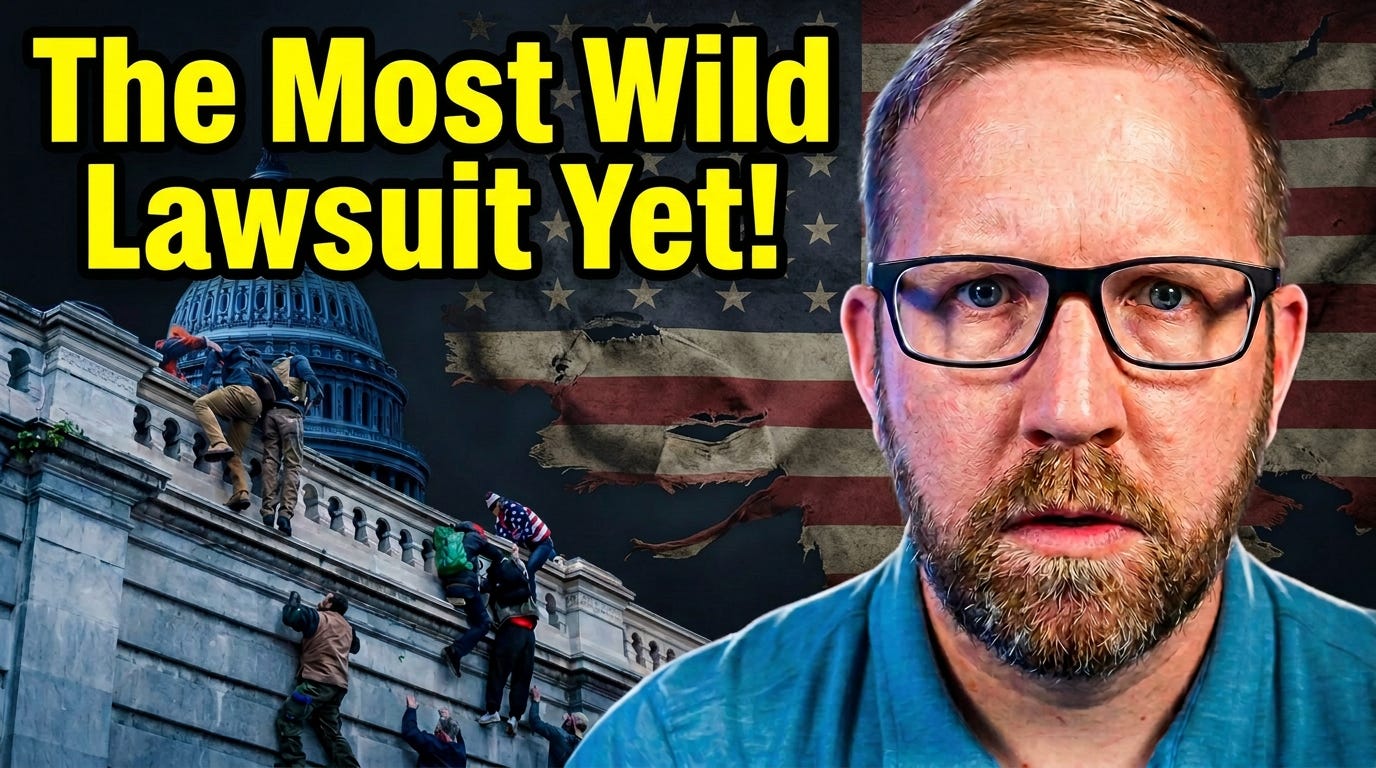
Twelve people charged in connection with the January 6, 2021 attack on the United States Capitol have sued the federal government, with each plaintiff seeking at least one million dollars in damages for what the filing calls malicious prosecution and emotional distress. The case, Andrews v. United States, was filed Friday in federal district court in Washington.
Their theory is not that they were treated too harshly. Their theory is that January 6 never happened the way the country saw it. The complaint alleges the riot was manufactured, a federal operation built to take a peaceful conservative protest and give it, in the filing’s own language, the appearance of a riot staged for the cameras.
That comes to twelve million dollars, drawn from taxpayers, as compensation for an attack on the government those taxpayers fund.
One of the plaintiffs is Roberto Minuta, an Oath Keeper convicted by a jury of seditious conspiracy in one of the most closely watched prosecutions to emerge from that day. Seditious conspiracy is the charge federal prosecutors bring when people conspire to use force against the authority of the United States. Minuta was sentenced to more than four years.
What the complaint alleges
The Ticktin Law Group, headed by conservative attorney Peter Ticktin, describes an operation months in the making. The filing places the start of the plot no later than September 2020 and says conspirators coordinated through Zoom meetings before the certification of the 2020 election.
The mechanics are unusually specific. According to the complaint, operatives would break the Capitol windows themselves so that compatriots and foreign participants could climb inside and unlock the doors from within, allowing the crowd outside to be herded into the building. Herded is the complaint’s own word for the thousands of people who walked in.
The entire chain of events, the filing says, was set off by one unidentified man it calls an instigator. The complaint does not name him. It does not identify who he worked for, produce a photograph, or offer any documentary trail.
It provides exactly one identifying detail. He was wearing a red MAGA cap with the price tag still attached.
That is the evidentiary foundation for a twelve million dollar claim against the United States government. Somebody was wearing a new hat.
The date at the center of the case
Set the hat aside and look at the calendar, because that’s where this filing runs into a wall.
September 2020 is when the plaintiffs say the federal conspiracy began. In September 2020, Donald Trump was President of the United States. William Barr was Attorney General and ran the Justice Department. Christopher Wray, appointed by Trump in 2017, was Director of the FBI. The Department of Homeland Security was under a Trump installation. By January 6 itself, the Pentagon was being run by an acting secretary Trump had put in place within days of losing the election.
Every federal agency that would have had to participate in the operation these twelve men describe was, during the precise window they specify, under the direct control of the president they went to the Capitol to keep in power.
Taken at face value, the entrapment claim in this lawsuit is a sworn allegation that the Trump administration set up its own supporters.
Trump is both the architect and the alibi
The filing does not treat that as a problem. It leans on Trump’s clemency as proof of its case, citing the pardons and commutations as the basis for the damages it demands.
That clemency came fast. On his first day back in office, Trump signed an executive order granting sweeping relief to the more than 1,500 people charged with January 6 crimes, and separately commuted the sentences of 14 people convicted in the Oath Keepers and Proud Boys seditious conspiracy cases.
Minuta was one of the 14. His sentence was commuted, not pardoned. A commutation ends a punishment. It does not vacate a conviction, and it does not touch the verdict a jury returned after watching the evidence. Roberto Minuta remains a man convicted of seditious conspiracy against the United States who is now asking that same United States for a million dollars.
Follow the argument all the way down, and it needs two incompatible things to be true at once. The man who was commander in chief during the alleged plot is also the man whose signature is offered as evidence that the plot was real. He ran the trap and certified that it existed. The complaint never reconciles those, because reconciling them would end the case.
This is a pipeline, not a one-off
The lawsuit is not an isolated stunt. It is the twelfth of its kind, part of at least a dozen January 6 compensation cases that have moved into federal court as claimants complete the administrative process required by federal law before suing the government. Dozens of people charged or convicted in the attack have now filed.
There was almost a fund waiting for them. Earlier this year, the Justice Department moved to create a $1.8 billion pool for alleged victims of government weaponization, a proposal widely understood to be aimed at January 6 defendants and structured as part of a broader arrangement to resolve Trump’s own $10 billion lawsuit against the IRS. Acting Attorney General Todd Blanche abandoned the plan after Republicans in Congress objected. Trump has continued to push for it.
That is the fight underneath all of this. Not whether one filing is absurd, but whether the federal treasury gets converted into a settlement fund for the people who stormed the Capitol.
What the record still says
Roughly 140 law enforcement officers were injured on January 6. More than a thousand people were convicted or pleaded guilty. Ordinary Americans sat on juries in Washington, watched hours of footage, and returned verdicts based on what they saw.
Clemency did not undo any of that. It ended sentences. It did not rewrite the day, and it does not convert a conviction into a claim on the public treasury.
The complaint asks the country to believe that American democracy was brought down by a mystery man in a new hat, acting on behalf of a government that Donald Trump was running at the time.
A price tag left on a baseball cap is not evidence of a federal conspiracy. It is evidence that somebody bought a hat.
Democratic Reporter is a grassroots media organization. We do not accept outside funding from billionaires or other investors. We will always be run by the guiding principles we share with our supporters. Please consider subscribing to help us grow our messaging to a larger audience of like-minded people.


