

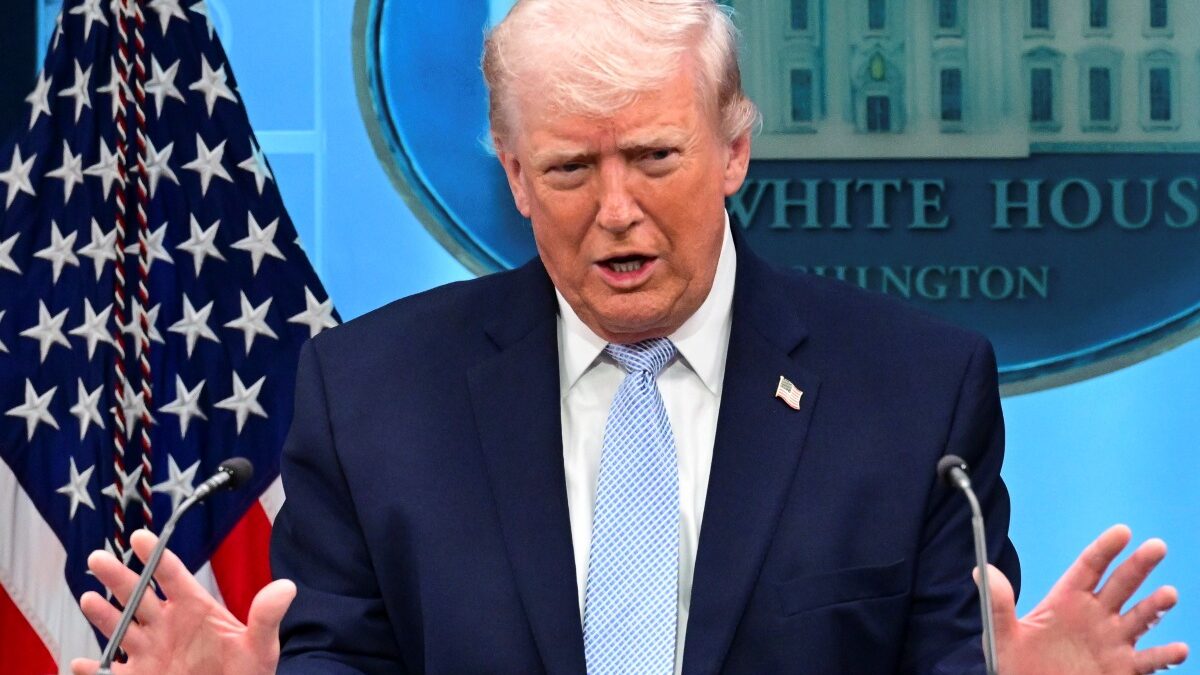
Picture the sidewalk outside the northwest gate of the White House on Saturday morning. Three reporters show up for work the way they do every day. Betsy Klein of CNN. Akayla Gardner of MS NOW. Cheyenne Haslett of Politico. Their badges do not work. The Secret Service takes the badges. Two of them go on live television from the sidewalk to report that they have just been locked out of the building they cover.
Inside, their workspaces sat empty.
By Monday, those three newsrooms had sued the president in federal court, and the White House had launched a 24/7 channel of its own called Trump TV.
That is the sequence. Lock out the reporters, then open your own channel. And if you have followed press freedom stories in other countries, you have seen this sequence before, in this order, with the same explanation attached to it.
The Friday Announcement
Trump announced the ban on Truth Social on Friday afternoon, saying these outlets should not be able to report what he called fiction and lies about him, and warning that other outlets would follow. The reporters found out what that meant the next morning when security took their credentials.
The three organizations went to court on Monday, telling a federal judge that the government was punishing them for the content of their reporting. Their filing runs 27 pages and argues the ban is viewpoint discrimination, which is about as close to a bright line as the First Amendment has. The case landed in front of Judge Timothy Kelly, who Trump himself nominated in his first term.
Jacqui Heinrich, who leads the White House Correspondents’ Association, made the point that matters most here. The standard used to throw out these three, she warned, could be used on any outlet later.
That is not a hypothetical. Trump said other outlets would follow. He said it out loud.
Manila, 2018
Now go back eight years and about 8,500 miles.
In February 2018, Rodrigo Duterte’s government in the Philippines barred a reporter from the presidential palace after a top aide accused her outlet, Rappler, of publishing fake news. Her name is Pia Ranada. She had been covering the president full time, and she had a reputation for asking him uncomfortable questions.
Journalists in Manila pointed out that it was the first time since the Marcos dictatorship that a sitting president had banned specific reporters from the palace grounds.
Then the ban grew. Two weeks later, Ranada showed up to cover an entrepreneurship summit at a convention center, an event Duterte was attending as guest of honor, and was told she was not on the list. The ban now covered presidential events anywhere, including ones thrown by private businesses.
And when Rappler asked how she was supposed to do her job, the presidential spokesman had an answer ready. He texted her that she could watch it on PTV or Facebook. PTV is the Philippine government’s own television network.
Ban the reporters. Point the public at the state feed. Insist nobody is really being banned.
The Monday Channel
The White House launched Trump TV on Monday evening at 7 p.m. Eastern, on YouTube and on its own website. The formal name is “TRUMP TV: The Essentials Station,” and the pitch is the administration’s biggest moments in one place, streaming around the clock.
The debut was not exactly live. The first thing the new 24/7 channel streamed was a speech from July at Mount Rushmore, in which Trump described his political opponents as godless and evil communists. A deputy assistant to the president called the channel a stream of the administration’s greatest hits, unfiltered.
Here is the part that gives the launch its shape. The White House television pool, the rotating arrangement where the major networks share footage of the president with everyone else, had broken down that same day. CNN was scheduled to shoot Trump’s departure for the United Nations General Assembly. Instead of replacing CNN, the four other networks suspended pool coverage. There was no traditional camera on the president leaving for New York.
So on the day independent cameras stepped back, the government’s own camera came on.
Step Two Happened Quietly In 2025
The lockout is the loud part. The quiet part happened a year and a half ago, and it is the piece that makes the lockout possible.
For roughly a century, the correspondents’ association decided which reporters filled the small pool that follows the president into the Oval Office and onto Air Force One. That was not a partisan arrangement. It was just how it worked, under presidents of both parties.
In February 2025, the White House press office took that job for itself. It later cut the wire service slot, which had guaranteed spots for the news agencies that supply small outlets everywhere, and added a “new media” seat that outlets apply for and the press office awards.
Poynter went and counted who actually got the seat. The invitation went to 32 outlets, and conservative outlets took it disproportionately often, occupying the slot in 55 of the 74 pools that included one. The occupant of the new media seat at briefings gets the first question.
Fill the room with friendly questioners first. Remove the unfriendly ones second. Open your own channel third.
Budapest Ran The Same Play
Viktor Orbán never had to lock reporters out of anything in Hungary, because he did not need to.
On November 28, 2018, a single day, 476 media outlets were handed over for free by businessmen friendly to Orbán’s party, all of them going to a foundation called KESMA that had been created only a few months earlier. Regional newspapers, radio, television, news portals.
A merger that size required competition review. So a week later, the government issued an order declaring the whole thing a matter of national strategic importance, and the competition authority closed its file. The end result was that 40% of the revenue in the Hungarian news and public life market sat inside one organization whose outlets functioned as government mouthpieces.
Orbán did not shut down the press. He reorganized who owned it.
What Actually Stops This
Here is the honest accounting, and it is better news than the last few paragraphs suggest.
American courts have not gone along with any of this. Trump barred a CNN reporter in his first term and lost. He barred the Associated Press over the phrase Gulf of America and lost. The Kennedy Center board shut the building hours after a judge ruled, which is its own story about how this administration handles losing in court, but it lost there too.
The networks did something this week that is rarer than a lawsuit. They gave up their own access rather than take CNN’s place in the pool. Fox included.
And then there is Hungary, which is the part of this story nobody expected to be able to write. Orbán had the 476 outlets. He had the friendly foundation, the gerrymandered map, and 16 years in office. On April 12, 2026, Hungarian voters handed him a landslide defeat anyway, with turnout near 79%, the highest since the end of communism. JD Vance had flown to Budapest days earlier to appear onstage with him.
The machine did not save him. People still had to show up to beat it. But it did not save him.
Trump TV opened with a rerun. The three newsrooms he banned are still reporting, still suing, and still on the air.