



Michael Whatley, the former Republican National Committee chair now running for North Carolina’s open U.S. Senate seat, has settled on an explanation for the wave of resistance to AI data centers. He says it is fake. Asked where he stands on the issue, Whatley questioned whether the opposition is organic during a July radio interview, telling listeners they had to “remember that this opposition to data centers is not organic” and that it “is being ginned up.”
Whatley has paired that claim with a national security argument. He told Spectrum News that the country cannot afford to lose the AI race to China, while allowing that data centers should not become a burden on local communities. His campaign later told CBS 17 that Whatley believes data centers should receive no special subsidies and should cover every dollar of the grid upgrades they require, with nothing shifted onto residential ratepayers.
The trouble with the “ginned up” theory is that the evidence against it is everywhere, and a great deal of it is in Whatley’s own state.
The Opposition Whatley Says Isn’t Real
New York this summer became the first state to enact a moratorium on new large data centers, joining more than 100 cities, towns, and counties across the country that have already hit pause on the facilities.
The pauses are only part of the picture. Organized local opposition blocked or delayed 75 projects worth roughly $130 billion in the first three months of 2026 alone, according to Data Center Watch; about the same number of projects were affected in all of 2025.
Whatley does not have to look far to find it. Dozens of North Carolina counties and towns have enacted temporary moratoriums on new data centers this year. In June, Charlotte’s city council voted unanimously for a 150-day pause before a packed chamber, in a scene Carolina Public Press described as familiar from town halls and county commission chambers across the state.
Those hearings have not been quiet. Tempers flared in Greensboro this month as residents filled a public hearing on the city’s data center moratorium, with one telling the council the facilities are already killing people. Alamance County commissioners heard from 42 speakers over three hours before imposing a year-long moratorium, and Northampton County residents showed up in May with a petition and left with a 32-month pause.
The same pattern is playing out nationally. The Associated Press found that municipal board meetings in farming towns and suburbs that once drew a handful of people are now packed with angry residents pressuring officials to reject data center proposals. Near Syracuse, more than 350 residents turned out for a town board meeting in Lysander, New York, before the board unanimously approved a six-month moratorium.
What AI Data Center Polls Are Actually Saying
Whatley could also have simply looked at the polling, and Gallup’s numbers are not subtle. In its first survey on the question, conducted March 2 through 18, Gallup found that 71% of Americans oppose the construction of a data center in their area to support AI, including 48% who strongly oppose one. Just 27% favor the idea, and only 7% favor it strongly.
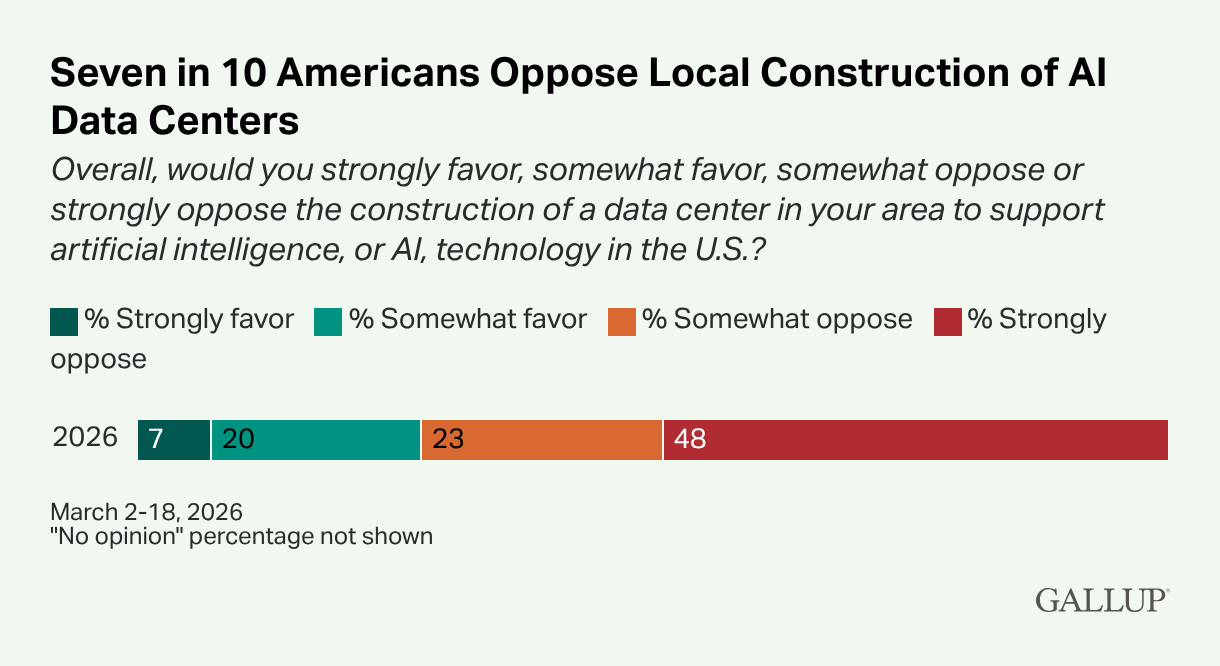
For comparison, Gallup asked about nuclear power plants in the same survey and found 53% opposed to one being built nearby. Since Gallup began asking about local nuclear plants in 2001, opposition has never topped 63%. Americans, in other words, are now more willing to live near a nuclear reactor than an AI data center.
Other pollsters see the same thing, and they see it getting worse. The Annenberg Public Policy Center at the University of Pennsylvania found that 61% of adults oppose new data centers in their area, up 12 points since the spring, with majorities of Democrats, Republicans, and independents all opposed.
A poll by Embold Research for Heatmap released last week put opposition at 75%, with 61% strongly opposed, compared with 42% opposition a year earlier.
Whatley’s own state is moving in the same direction. An Elon University Poll released this month found that opposition to local data centers has climbed to 53% among North Carolinians, up from 44% in March, with majorities of Democrats, independents, and women opposed and pluralities of Republicans and men joining them. That shift came even as a pro-data center lobbying group spent more than $367,000 on a North Carolina ad campaign promoting the industry’s economic upside.
Why People Are Angry About AI Data Centers
Gallup went back in April and asked opponents to explain themselves, and the answers were not mysterious. Half pointed to the facilities’ heavy consumption of resources such as water and energy, and 16% cited pollution, including noise. The cost concern has hard numbers behind it. Researchers at North Carolina State University, Carnegie Mellon, the University of Pittsburgh, and the University of Toronto projected in May that demand from data centers and cryptocurrency mining could raise power costs by up to 57% in some parts of the country by 2030, with a national average increase of 6% to 29%.
Some of that is already on the bill. In the PJM grid, which serves 13 states and the District of Columbia, the market’s independent watchdog found that data center demand was responsible for $23 billion in costs to secure power supplies, costs that get passed down to consumers and that the watchdog described to PJM as a massive wealth transfer.
The health concern has a face, and it is in Boxtown, a neighborhood in South Memphis, Tennessee. Elon Musk’s xAI stood up its Colossus supercomputer there with dozens of methane gas turbines running without air permits under a loophole for temporary equipment, and then applied for permits allowing 15 turbines to run around the clock for at least five years. Environmental groups flew thermal imaging over the site and counted as many as 35 turbines. The Shelby County Health Department approved the 15-turbine permit in July 2025 over the objections of residents and the NAACP.
Residents of Boxtown, the majority-Black neighborhood closest to the facility, testified at public hearings about a rotten-egg smell hanging in the air and worsening smog’s effect on their heart and lung health. At one hearing, people held up inhalers and portable oxygen tanks and described asthma and cancer cases in their families that they attribute to the pollution.
Researchers at the University of Tennessee, analyzing satellite data for TIME, found that peak nitrogen dioxide levels rose 79% around the data center and 9% in Boxtown itself, and a South Memphis physician called the jump alarming. Tennessee Lookout reported that researchers estimated the pollution spike translates to as much as $44 million a year in health damage from premature deaths, hospital visits, and lost productivity. In January, the EPA closed the loophole xAI had used to run the turbines without Clean Air Act permits.
His Own Republican Party Admits There Is Heavy Opposition
Whatley’s dismissal puts him at odds with the people running his party’s Senate campaigns. A leaked National Republican Senatorial Committee memo, first reported by Axios, calls data centers a sleeper issue for the entire election cycle and warns that voter hostility is already threatening Republican Jon Husted in Ohio, where Democrat Sherrod Brown has made opposition to the facilities a centerpiece of his campaign. The memo cautions that if voters’ perceptions are not fixed quickly, the campaign against data centers will spread far beyond Ohio.
The “not organic” line is not Whatley’s alone. Republicans have increasingly leaned into claims of foreign interference in the data center fight, with Interior Secretary Doug Burgum telling an industry audience the opposition was not organic and local, and Katie Miller, the wife of top White House aide Stephen Miller, writing that the push is fueled by Chinese and Russian actors. Kevin O’Leary, who is backing a $100 billion data center project in Utah, went further and named specific Utah organizations as Chinese-backed cells. The people he named told NPR they had no idea why they were on his list.
The researchers who study this do not buy it. Fortune reported that experts see little evidence for the China claims and plenty of evidence that the anger is real. Ben Green, a University of Michigan professor who studies data policy, put it plainly: “Show up to a town hall, show up to a city council meeting,” and you will see residents who are clearly upset about what is being built next to them.
President Trump, who backed Whatley for RNC chair and for this Senate seat, has told local officials that resistance is futile and that it falls to them to convince constituents data centers are good for them, adding, “You can’t fight it.”
Whatley’s problem is not that North Carolinians were tricked into opposing data centers. It is that they have been paying attention, to their electric bills, to the hearings in their own counties, and, in places like Boxtown, to the air. The same Elon poll that found a majority of North Carolinians against local data centers found Whatley trailing Roy Cooper 53% to 42% among likely voters. Telling those voters their concerns were manufactured is an odd way to close that gap.
If you can afford to chip in less than $5/month as an annual supporter you can help us increase our coverage of Trump’s illegal and immortal activities and expose his administration. If you don’t have the means to contribute right now, please consider a free subscription so we can reach as many people as possible with our grassroot campaign! We’d love to continue this week with your support!
Michael Whatley would rather tell voters their concerns are fake than answer them, and putting that on the record is exactly what Democratic Reporter is here to do. We will keep holding the corrupt Trump administration and the candidates carrying its message accountable for the distance between what they say and what people are living through. If you oppose an AI data center in your community, tell us why in the comments, share this story, and remember to vote blue in November.


