


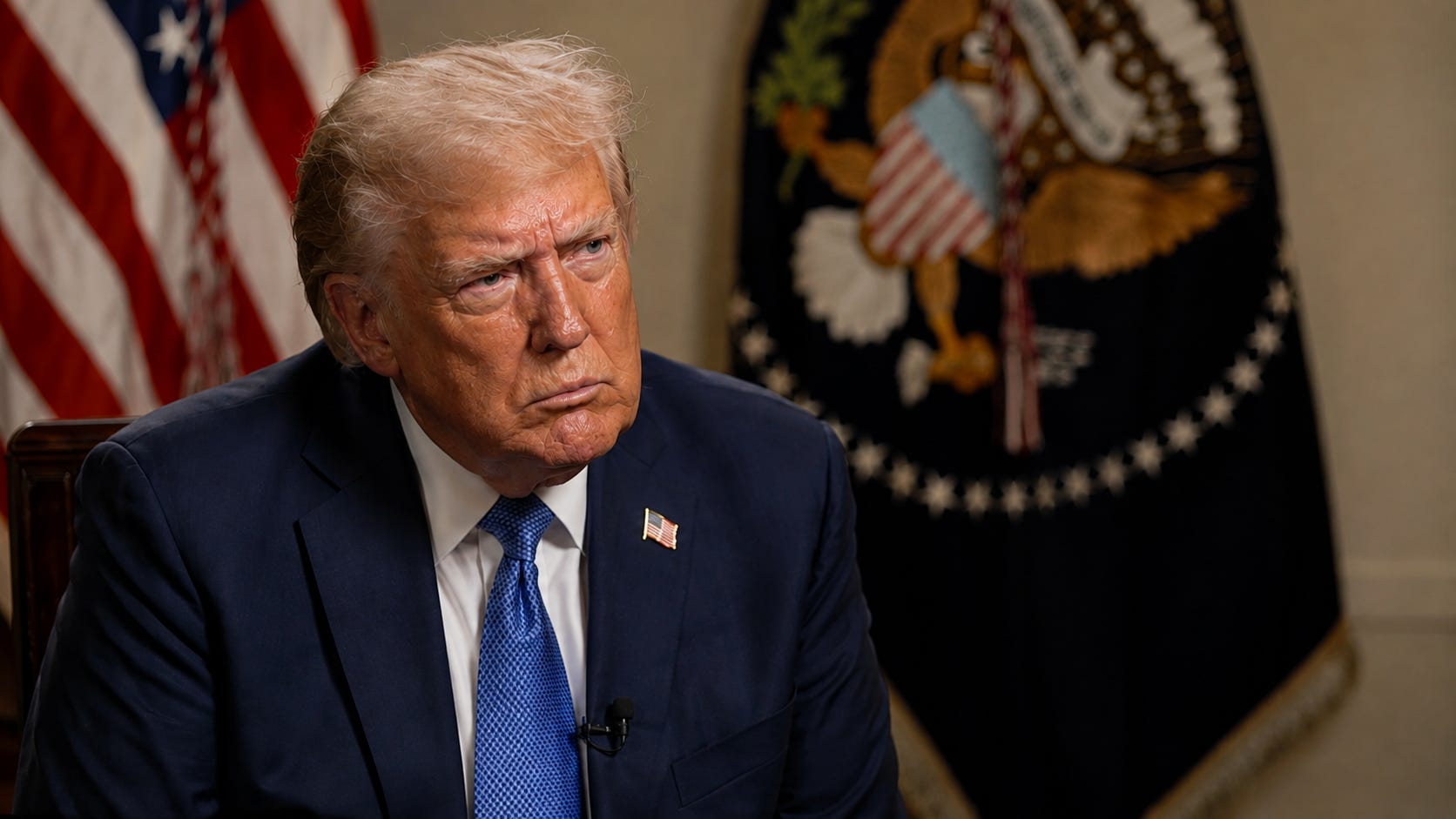
Donald Trump made two competing claims in the same breath about voter fraud in Michigan, and they are completely incompatible.
First, he boasted that he carried Michigan easily in 2024. Then, moments later, he announced that Mike Rogers had been robbed of the Senate seat on that very same ballot. “I happen to think he won,” Trump said. “I think it was a rigged deal. I think they rigged him out of it.”
Only one of those statements can survive the math behind the claim. Donald Trump defeated Kamala Harris in Michigan by roughly 80,000 votes, a margin of about 1.4%. Further down the same ballot, in the same precincts, which were processed by the same clerks and tabulated on the same machines, Rogers lost to Elissa Slotkin by roughly 19,000 votes, or 0.3%.
Voters filled out a single sheet of paper. If that sheet was corrupted badly enough to steal a Senate race, it was corrupted for the presidential line printed inches above it. Fraud does not descend the ballot and then politely step around the man now describing it.
What makes Trump’s claim even harder to take seriously is that Rogers himself didn’t make it when it would have mattered. Right after losing the election, he immediately conceded within a day of the results.
Rogers never raised allegations of misconduct, and said nothing about stolen votes while the count was still fresh and the evidence, had any existed, would have been recoverable. He stayed quiet through certification. He stayed quiet through the standard post-election audit that confirmed the outcome.
Then, nearly a full year later, with a second campaign underway, a story about a van arriving in Detroit with ballots in the small hours after Election Day began to surface in his remarks to small audiences around the state. Reporters asked his campaign to produce something — a name, a location, a document, anything. The campaign did not answer. Rogers spent the better part of a week declining to take questions about it.
The timing tells you what the story is for. It did not appear when Rogers lost. It appeared when Rogers needed a Republican primary electorate to forgive him for losing.
There is a further wrinkle: Rogers used to be the Republican who said this sort of thing was corrosive. One day before the Capitol attack, an op-ed under his name argued that courts and observers from both parties had found the 2020 election free and fair, and that suggesting otherwise was self-serving and stoked discord in the country.
Weeks earlier, he had urged Michigan officials to certify their results and told Trump to accept the outcome and begin an orderly transition. He was correct on both counts. He has since concluded that being correct was worth less than being endorsed.
That endorsement cleared his path completely. Rogers drew no serious primary opposition and advanced to a general election against Abdul El-Sayed on Tuesday, in a contest that could decide control of the Senate.
Within twenty-four hours, Trump was on Truth Social describing Wayne County as one of the most corrupt voting jurisdictions in the world and predicting that fraudulent mail ballots would surface at the last moment, telling supporters to get ready for another rigged election.
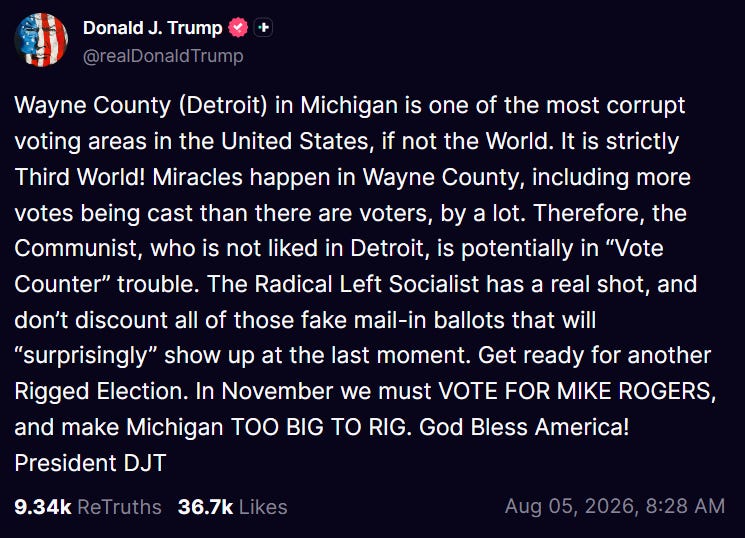
There is no evidence for any of it. Courts, election administrators and post-election reviews have looked repeatedly and found nothing that changed a Michigan outcome.
Notice what the sequence accomplishes. The fraud is announced before the ballots exist. Whatever happens on November 3rd, the framework for rejecting it is already public, already repeated, and already believed by the people most likely to act on it. That is not a prediction. It is a contingency plan.
And it has an operational side. Rogers has promoted a plan to recruit off-duty and retired police officers to serve as poll watchers in Detroit, which is a specific proposal aimed at a specific city with a specific demographic profile, dressed up as election integrity.
Uniformed authority hovering over Black election workers in the state’s largest city is not oversight. It is a message about who is presumed to be cheating.
Michigan Democrats have pointed out the obvious contradiction all week because it is not subtle. A man cannot campaign on the strength of a Michigan landslide and simultaneously insist the Michigan count was fixed. He can only do that if his audience is not expected to check.
The race is on November 3rd, and our most useful response to people who have already announced they will call your vote fraudulent is to cast enough votes that the accusation collapses under its own weight.
Democratic Reporter is a grassroots media company. We believe media should be 100% free of investors with their own agendas. Please consider subscribing to our Substack so we can keep producing progressive news that holds the Trump administration and the entire Republican Party accountable for their actions.


