


John Steinbach has lived in the same house in Manassas, Virginia, for almost 40 years. He knows what his electric bill is supposed to look like. For most of that time it’s hovered around $100 a month, the kind of number you pay without really reading it.
Then this past January, he opened a bill for $281.
He told reporters he’d never seen anything like it. And he had a pretty good idea where to look, because Steinbach lives in Northern Virginia, the stretch of the country with the densest concentration of data centers anywhere in the world.
That bill is only part of the AI data center picture.
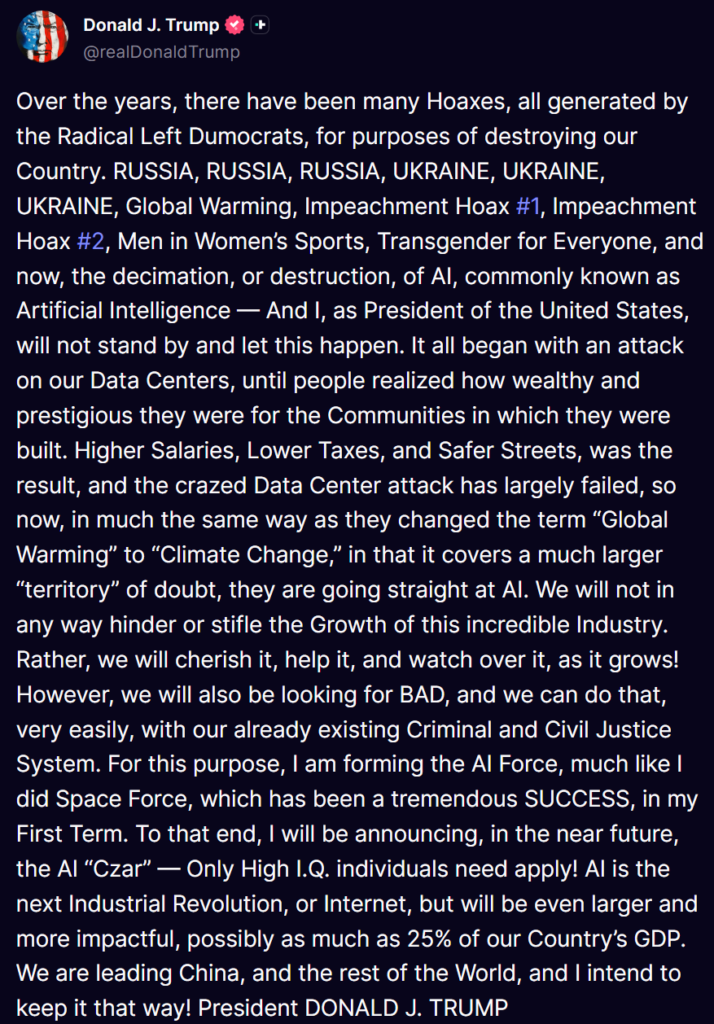
On Saturday, Donald Trump went on Truth Social and folded concerns about artificial intelligence into his long list of what he calls Democratic hoaxes, right alongside Russia, Ukraine, global warming and both of his impeachments. He wrote that the attack on AI started with data centers, and that it fizzled once people realized how much wealth those facilities brought to the towns around them. Higher salaries, lower taxes and safer streets, he said. That was the result.
Then he announced he’s forming an “AI Force,” modeled on Space Force, and promised to name a new AI czar soon. Only high IQ people need apply, he wrote.
So let’s do the thing the president didn’t do. Let’s go look at the towns.
The Hoax That Isn’t Coming From Democrats
Before we get to the data centers, it’s worth being clear about who’s actually raising the alarm on AI. It isn’t a Democratic talking point. Trump’s post landed even as the industry’s biggest leaders have been calling for stronger safety rules, and as researchers and tech figures have pushed for a slower pace of development. Those are the warnings he’s calling a hoax.
His answer to them is that the government won’t hinder or stifle the industry in any way, and that anything bad can be handled through the criminal and civil courts. Think about what that means for a second. The courts are where you go after someone has already been hurt. That isn’t a safety plan. It’s a lawsuit waiting to happen.
As for the AI Force itself, Trump offered almost nothing. There’s no stated mission, no budget and no word on where it would sit inside the government. And the man who held the AI czar job before, venture capitalist David Sacks, told a conference just this week that “the starting point for talking about AI regulation is to realize the regulations that we already have.” So the president is building a new force to enforce rules his own top AI adviser seems to think are already good enough.
What The Power Bills Actually Say
Here’s where Trump’s version of events runs into Steinbach’s mailbox.
Residential electricity prices rose 7.1% in 2025, more than double the rate of inflation, and climbed past 20% in some states. A deep investigation by Consumer Reports found that while the rush of AI data centers isn’t the only thing pushing prices up, it’s a significant factor in rising bills alongside inflation and an aging grid. A Bloomberg analysis cited in that report found that in areas with heavy concentrations of data centers, electricity prices jumped 267% over five years.
Virginia is the clearest picture of where this goes. In 2024, data centers accounted for almost 40% of all the electricity used in the entire state. Nearly three quarters of Virginia voters now blame the facilities for their rising power costs, and nationally, 78% of Americans say they’re worried the new data centers will push their own bills higher.
Ari Peskoe, who runs Harvard Law School’s Electricity Law Initiative, has explained the mechanics pretty plainly. Utilities build the new power lines and plants these facilities need, and under the way the utility business has always worked, everyone on the grid ends up paying for them.
Now, to be fair about what the research shows, a team at Rutgers looked at data center openings from 2014 through 2024 and found no robust evidence of bill increases in the surrounding areas during that period. But those same researchers warned that the era of massive AI facilities could look very different, and they pointed to the regional grid market serving 13 states and Washington, D.C., where one key auction price leapt from $28.92 to $269.92 per megawatt day. That’s the world Steinbach’s bill came from.
Lower Taxes For Whom?
Trump says data centers brought lower taxes. The tax breaks certainly went somewhere, but it wasn’t to the neighbors.
According to the watchdog group Good Jobs First, Virginia and Texas each hand out roughly $1 billion a year in data center exemptions, and many states refuse to disclose their subsidy deals at all, including how much money is involved or which companies get it. Kasia Tarczynska, a senior analyst with the group, called data centers “one of the most subsidized industries” it has seen in its 27 year history.
And the secrecy often starts before a single shovel hits the ground. Researchers at the University of Mary Washington looked at 31 Virginia communities with existing, approved or proposed data centers and found that 25 of them had nondisclosure agreements with local officials about the projects. In many of those places, residents didn’t even know a facility was being proposed, let alone how much water or power it would use.
The Salaries Nobody Can Find
Trump didn’t attach a single number to his claim about higher salaries, so let’s look at the numbers that do exist.
Data centers bring a burst of construction work, but once they’re finished, they tend to employ very few people. One estimate from the nonprofit Food & Water Watch put the entire nationwide data center workforce at as few as 23,000 people by the end of 2024. And when two business school professors studied the question last year, they found no clear evidence of local tech hiring growth in the places where data centers were built.
That’s the kind of gap you’d expect a president to explain before promising the whole country a salary bump. He didn’t.
Safer Streets Or Busier Ones
This might be the claim that stings the most for the people living next to these projects.
In Richland Parish, Louisiana, Meta is building a data center campus called Hyperion that now covers 3,650 acres, twice the size of New Orleans’ main airport. A local news analysis of police records found that vehicle crashes in the area jumped by more than 600% in the first nine months of 2025 compared with the year before. Meta says it’s building new roads to divert truck traffic, has commissioned a traffic study and is working with local police.
In Fayetteville, Georgia, where another massive campus is going up, residents describe dump trucks, flatbeds and cement trucks tearing down roads that used to be quiet. Homeowners in Georgia have also complained about contaminated well water and damaged roofs that they blame on nearby construction, and in some places, people have watched high voltage transmission poles go up in the middle of their own yards.
Water And Air That Don’t Come Back
Around Phoenix, one of the most water stressed metro areas in the country, data centers already use about 385 million gallons of water a year just to cool their equipment. The nonprofit Ceres projects that could climb to 3.7 billion gallons once the planned facilities come online, an 870% increase. Nationally, about two thirds of data centers built since 2022 sit in areas already facing water stress, according to a Bloomberg investigation.
Then there’s the air. Because these facilities run around the clock, operators often install diesel and gas generators for backup power, and the pollutants those generators release have been linked to cancer, heart disease and respiratory illness. A Kapor Foundation report found that 82% of California’s data centers sit in communities already facing poor air quality.
Trump likes to brag that data centers are building their own beautiful power plants. In Memphis, Tennessee, that looks like Elon Musk’s xAI running portable methane gas turbines to power its Colossus facilities, in neighborhoods that were already overburdened by pollution before the turbines arrived.
The People He’s Calling Hoaxers
So who exactly is behind this supposed hoax? It turns out it’s most of the country.
An NBC News poll conducted from late August into early September found that 69% of Americans oppose building data centers locally, with 45% saying they strongly oppose it. Trump’s response a few weeks earlier was to warn that communities that turn these projects away will end up “backwards and poor.”
That opposition isn’t just a mood, either. Community pushback blocked or delayed $98 billion in data center projects in a single three month stretch of 2025, and at least 25 projects were canceled last year because of local objections. Even Republicans are feeling it. Texas Governor Greg Abbott paused new data center projects in his state, which Trump called a mistake, and the Senate GOP’s campaign arm warned AI companies that the backlash could hurt Senator John Husted’s reelection chances in Ohio.
That’s not a Democratic hoax. That’s voters in red and blue states alike looking at their bills, their roads and their water and deciding they don’t like what they see.
Which brings us back to John Steinbach and his $281 bill. Trump’s post promised that his administration would cherish this industry, help it and watch over it as it grows. It didn’t promise a single thing to the man in Manassas, or to the families in Richland Parish, or to the neighborhoods breathing turbine exhaust in Memphis. For them, the president’s plan is simple. If something goes wrong, they can take it up in court.