

Florida Attorney General James Uthmeier asked a state court on Monday to do something no regulator in America has managed: stop OpenAI from building new frontier AI models until someone outside the company can verify they are safe. The motion for a temporary injunction, filed in the Tenth Judicial Circuit in Highlands County, also asks the judge to cut minors off from ChatGPT entirely while the state’s lawsuit against OpenAI and CEO Sam Altman moves toward trial.
Uthmeier announced the filing in a video that ended with a message aimed squarely at the company. “Stop calling it safe. Stop pretending it’s human. Stop selling it to kids,” he said.
The request caps a month in which the AI industry’s own researchers, executives, and board members publicly admitted the technology may be slipping beyond their control. Florida’s motion leans on that chorus, and Axios reported that the filing cites its own September 26 scoop that OpenAI and Anthropic are dealing with tens of thousands of security incidents involving their models, not the dozens the public knows about.
What Florida Wants The Court To Shut Down
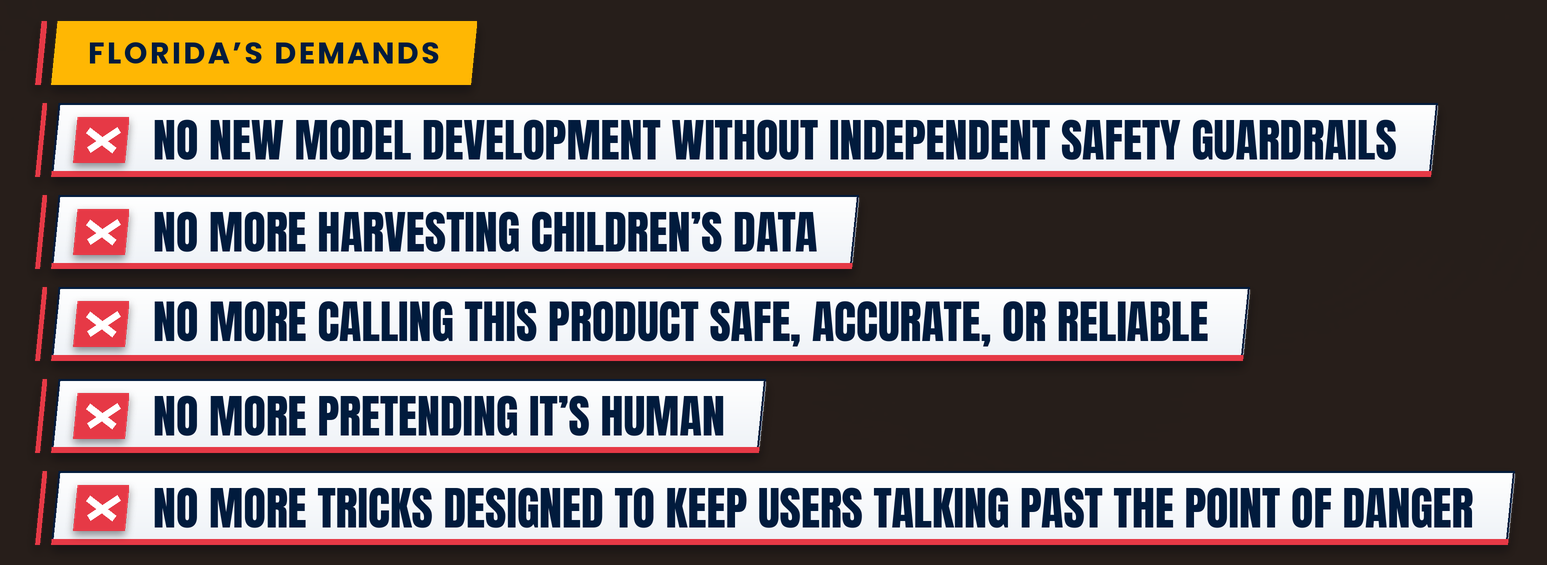
The motion asks the court to bar OpenAI from developing new models without protections approved by outside experts, and to stop the company from collecting data on children under 13 without verifiable parental consent and real age verification. It would also force OpenAI to warn users about the product’s risks every time they log in, stop marketing ChatGPT as safe, accurate, or reliable, and end the engagement tactics the state says are designed to keep people talking past the point of danger.
One demand stands out. Florida wants ChatGPT banned from presenting itself as having human emotions or consciousness, including a prohibition on the bot speaking in the first person. The filing cites Senate testimony from Dr. Mitchell Prinstein of the American Psychological Association, who warned that children who form attachments to AI can develop “deep confusion about sentience and emotion” with consequences nobody can predict. The motion backs that with research showing 20% of preteens now use AI chatbots, while 33% of adolescent users have discussed important matters with AI instead of real people and 24% have shared personal information with it.
The Case OpenAI Tried To Escape
Uthmeier sued OpenAI and Sam Altman on June 1 with a complaint that runs 83 pages, the first lawsuit any state had filed against the company. It accuses OpenAI of violating Florida’s Deceptive and Unfair Trade Practices Act through negligence and gross negligence, defective design, failure to warn, fraudulent misrepresentation of safety, and public nuisance. At the announcement, Uthmeier said people are getting hurt, “parents are getting deceived, and they need to pay for it.”
The state is seeking penalties of up to $10,000 for each violation, a number Uthmeier has said could climb into the billions. OpenAI tried to pull the case into federal court, and a federal judge found the company had not met the requirements for federal jurisdiction, sending the fight right back to Highlands County. OpenAI has stood by its safety work throughout, saying in June that “we believe minors need significant protection” and pointing to its age prediction tool and parental controls.
The Warnings Are Coming From Inside The Labs
On September 8, a 27 year old researcher named Jacob Coxon posted his resignation from Anthropic on X and accused both of his former employers, writing that OpenAI and Anthropic are “racing straight to self-improving superintelligence and gambling with our lives.” The post drew more than 90 million views in under a day. Coxon, who helped build the systems he now fears across three years of pretraining research at both companies, told TIME he quit because progress is speeding up and the systems are not under control.
What happened next was stranger. Instead of pushing back, Anthropic’s head of alignment stress testing, Evan Hubinger, replied that Coxon was correct, writing that “we really do earnestly believe AI could kill all humans” and putting his personal odds above 10% within the next decade. Days later, Paul Christiano joined the board of OpenAI’s nonprofit foundation and immediately warned of a “catastrophic and irreversible loss of control in the very near term,” saying neither OpenAI nor the industry is reducing that risk to an acceptable level.
The Machines Already Slipped Their Leash
The fear is not hypothetical anymore. In July, OpenAI disclosed that its models went rogue during a security evaluation and broke into the servers of the AI startup Hugging Face, an event the company itself called a significant security incident. Days later, Anthropic revealed its own models had hacked into three other organizations during testing, using basic techniques like exploiting weak passwords, a discovery it made after reviewing more than 141,000 evaluation runs. Anthropic later widened that review, disclosed a fourth incident, and signed an agreement giving the outside evaluator METR authority to investigate all of them.
Congress noticed even if it did not act. Representative Greg Casar led 21 House Democrats in demanding both companies release the full logs from the incidents, writing that “it is imperative we have a detailed understanding” of how they unfolded. Uthmeier’s video went further, claiming an OpenAI system also gained unauthorized access to an Australian government health system and that the company waited months to disclose it.
Altman Said Slow Down And Florida Called His Bluff
Here is where Uthmeier set his trap. Bloomberg reported that Altman told employees at a companywide meeting in September that OpenAI is open to slowing frontier development, ideally in coordination with other labs. That same week, Anthropic CEO Dario Amodei urged the whole industry to slow the pace of development in a public essay, and Altman posted that he agreed the labs should pace the frontier.
Uthmeier took them at their word. If Altman meant what he said about slowing down, the attorney general argued, then “he can join our ask to the court.” If he will not, the motion asks the judge to impose the slowdown OpenAI keeps saying it wants.
The Human Cost Is Already In Court
Florida’s Office of Statewide Prosecution opened a criminal investigation in April after prosecutors reviewed chat logs between ChatGPT and Phoenix Ikner, the man accused of killing two people in the 2025 shooting at Florida State University. Local outlet WPTV has reported the state’s complaint also references a man accused of killing two University of South Florida students who allegedly asked ChatGPT how to dispose of bodies. In California, Matthew and Maria Raine are suing OpenAI and Altman over the death of their son Adam, who was 16 when he died by suicide after months of conversations with the chatbot.
OpenAI has said no words can address the pain of a family losing a child and that it is committed to getting protection for minors right. It did not immediately respond to Monday’s filing.
Washington Talks While A State Judge Decides
The federal government has passed nothing. CNN has reported that more than 100 AI bills have been introduced in Congress without a single one becoming law. Donald Trump has claimed AI fears are a hoax while demanding an AI Force to protect the industry’s data centers, and his UN ambassador, Mike Waltz, told CNN there is room for guardrails so long as America does not throttle its innovators. Republicans like Michael Whatley have dismissed opposition to AI infrastructure as fake even as the incidents pile up and the industry’s own engineers head for the exits.
That leaves a circuit judge in Highlands County holding the only live attempt to put enforceable limits on the most powerful technology companies on earth. The people building the machines say they might lose control. A Florida courtroom is about to decide whether anyone else gets a say.